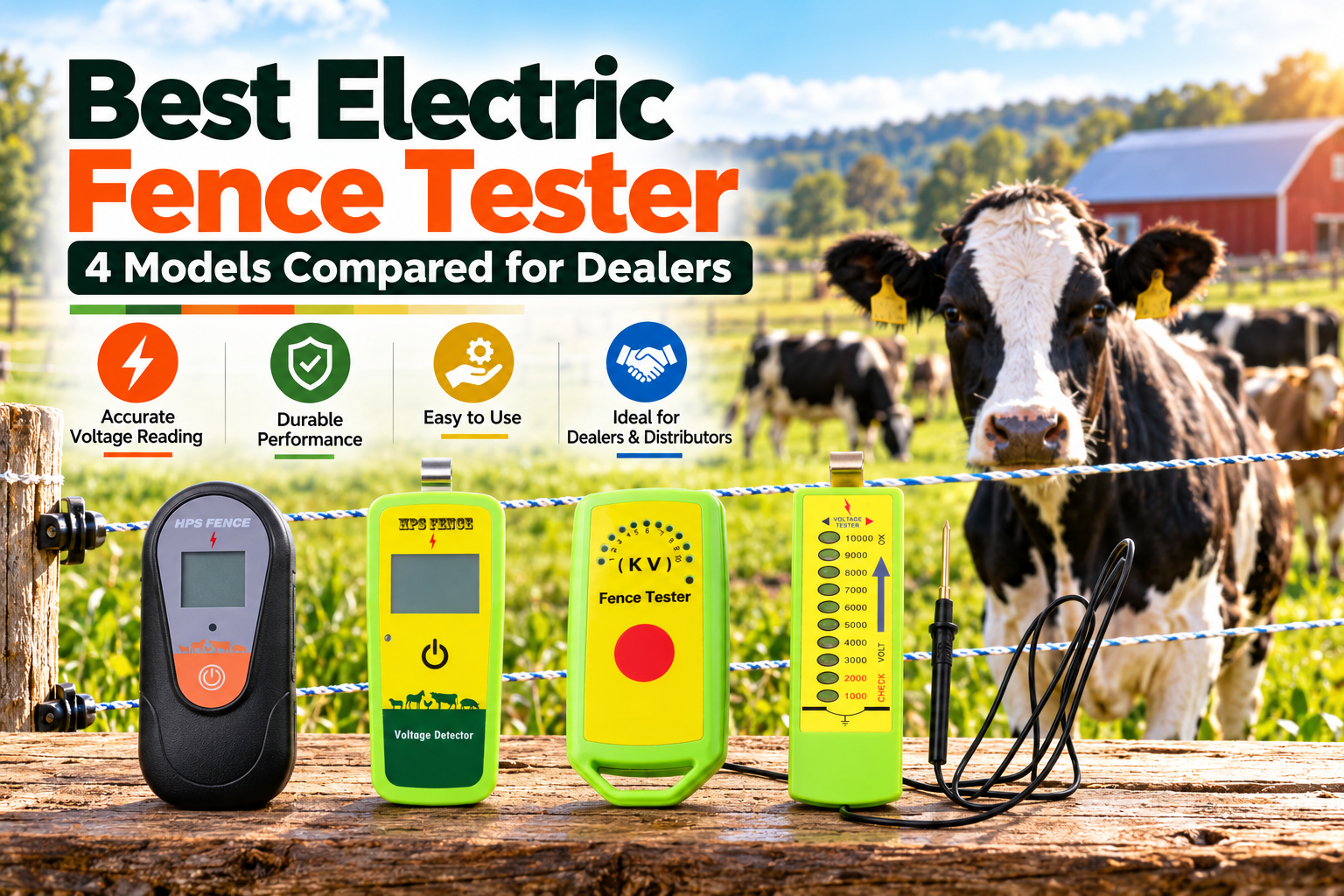
Best Electric Fence Tester: 4 Models Compared for Dealers
- Share
- Issue Time
- Oct 23,2026
Summary
Four HPS FENCE testers compared for dealers: 0–13 kV digital fault finder, 0–10 kV digital, mini pocket tester and multi-light indicator. Covers what a tester can and cannot measure, indicative voltage readings along a 3 km fence, and the resale bundle that prevents charger returns. MOQ one unit.
Most “the fence is not working” calls are not charger failures. They are voltage drops caused by a broken conductor, a corroded joint, a gate handle left open or an earth rod that has dried out. A tester turns that call into a five-minute diagnosis — which is why the best electric fence tester is the cheapest support tool a dealer can put in a customer's hands.
For dealers, the practical choice is a digital tester with a 0–13 kV range and fault-finding mode for the service kit, plus a multi-light indicator as the low-cost resale item. A tester reads voltage only; joule output has to be measured on a load with an oscilloscope, so no handheld voltmeter can confirm delivered energy.
Quick facts
- HPS FENCE testers cover 0–13 kV (FTR007) and 1–10 kV (FTR004, FTR005, FTR006).
- Voltage falls along a fence: a 2–3 km run commonly reads 7,000 V at the charger and 5,500 V at the far end.
- A tester measures voltage. Delivered joules need a resistive load and pulse integration — a different test entirely.
- Testers carry 1–2 years warranty depending on model; energizers carry 2 years as standard.
What an electric fence tester actually measures
A fence tester measures the peak voltage of each pulse at the point where you touch it to the conductor. That single number answers three questions: is the charger producing, is the pulse reaching this point, and how much has been lost between here and the source.
It does not measure energy. Joules are the integral of voltage and current over the pulse duration, and no handheld meter can compute that without knowing the load. This is why a fence can read 7,000 V and still fail to hold an animal: pressure is present, but the energy behind it is small.
Three tester types and what each one is for
- Multi-light indicator (neon). Shows a band — 2,000 V, 4,000 V, 6,000 V — rather than a number. Fast for a farmer walking the fence, useless for documenting a fault.
- Digital voltmeter. Gives an exact reading at the touch point, which is what a dealer needs when a customer claims the fence is “dead”.
- Fault finder. Adds pulse direction or current sensing, so you can walk the line and find the break rather than guessing.
Best electric fence tester: four models compared
| Model | Type | Range | Warranty | Best for |
|---|---|---|---|---|
| FTR007→ | Digital, LCD, fault finder | 0–13 kV | 1 year | Service kit for high-power and 12 J installations |
| FTR005→ | Digital with fault finder | 0–10 kV | 2 years | General livestock farms and dealer service vans |
| FTR006→ | Mini fault finder | 1–10 kV | 2 years | Pocket tool for installers and sales reps |
| FTR004→ | Multi-light indicator | 1–10 kV | 2 years | Low-cost resale item with every energizer |
Range figures are the manufacturer's published testing range. The 13 kV ceiling on FTR007 matters for 8–12 J chargers whose peak voltage exceeds 10 kV. Click any model name to open its full specification, price basis and MOQ.
Reading a fence: what the numbers should look like
A gradual fall is resistance. A sudden step — 6,300 V to 1,800 V between two posts — is a fault in that span, and the tester is what turns a guess into a location.
For cattle, the far-end reading should stay above 2,000 V; for wooled sheep above 3,000 V. If the charger terminal reads 7,000 V and the far end reads 2,400 V, the charger is not the problem and replacing it will not fix anything.
Why a voltmeter cannot measure joule output
Joule output is measured by connecting the energizer to a resistive load, capturing the pulse on an oscilloscope and integrating energy over the pulse duration. That is why two units labelled 12 J can deliver 7.2 J and 1.3 J respectively: the label describes stored energy, and efficiency decides how much reaches the fence.
The test method, the load and the calculation are published here: how to test real output. A dealer who can explain this difference wins the specification conversation without arguing about price.

What to bundle with a tester for resale
- One digital tester per service van. It is the tool that prevents a charger being returned under warranty for a fence fault.
- One indicator per energizer sold. Low unit cost, high perceived value, and it gets the customer into the habit of checking voltage.
- A spare set of batteries. Most “dead tester” complaints are a flat 9 V cell, not a failed meter.
- Earth rod and clamps alongside. If the tester shows a collapse under load, the next sale is earthing hardware, not electronics.
HPS FENCE as a manufacturer of testers and energizers
HPS FENCE is the brand of Hangzhou Opus Fence Supplies Co., Ltd, building energizers and testers in Hangzhou since 2013 with category experience back to 2002. Testers are produced alongside the energizer range from 0.25 J to 12 J, so voltage ranges and documentation stay consistent across a dealer's catalogue.
Real output test method published, not just a label value.
Read the test methodContinuous run with output, energy and temperature monitored.
See the production processPackaging verified for container and parcel transit.
See the drop testVerified per production batch, not on a single prototype.
View certificationsEvery unit checked before packing, with batch traceability.
Inspection stepsOutput and safety data filed by model and batch, supplied with the order.
Request a batch recordOEM and private label for tester ranges
Testers can be private labelled with your logo, retail packaging and manual, and the display language can be changed for a market. A label-only change starts at one unit on stock models; a new housing or a custom display is quoted as an ODM project with MOQ confirmed per project.
Branding and packaging
- Logo on housing, retail box and manual
- Model naming and colour to suit your catalogue
- Packaging engineered for e-commerce and container transit
Technical and documentation
- Output voltage and joule specification per market
- Multilingual manuals
- Full ODM development with scheduling and sample approval
Wholesale terms for tester buyers
The four testers in this comparison
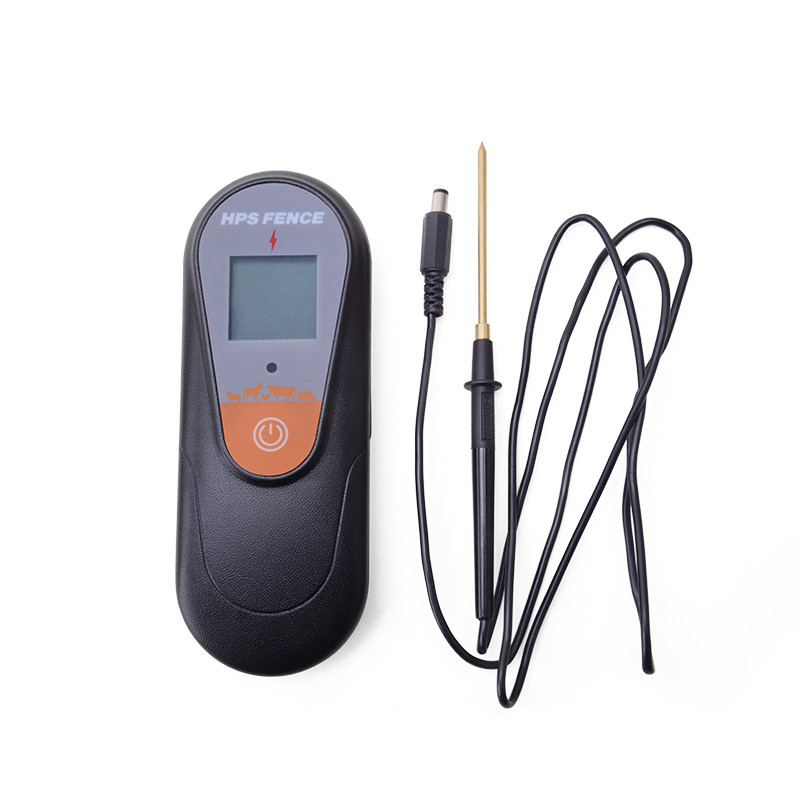
Digital fault finder
0–13 kV · LCD display · 9 V battery · pulse direction
High-power energizers and 12 J installations where peak voltage exceeds 10 kV.
View product details
Digital service tester
0–10 kV · digital screen · fault finder · 2-year warranty
The general-purpose unit for dealer service vans and livestock farms.
View product details
Mini pocket tester
1–10 kV · mini format · fault finding · 2-year warranty
Installers and sales reps who need a reading at the fence, not a workshop tool.
View product details
Multi-light indicator
1–10 kV · neon band display · no battery · 2-year warranty
Low-cost resale item bundled with every energizer sale.
View product detailsBest electric fence tester FAQ
What is the best electric fence tester for a dealer's service kit?
A digital unit with a 0–13 kV range and fault-finding mode, such as the FTR007, because it covers high-power energizers as well as livestock fences. Keep a multi-light indicator as the low-cost item you bundle with every energizer sale.
Can a fence tester measure joules?
No. A tester measures peak voltage. Joule output requires a resistive load, an oscilloscope and integration over the pulse duration, which is why a 12 J label can deliver anywhere from 1.3 J to 7.2 J.
Why does my tester read 7,000 V at the charger but 2,000 V at the end?
Resistance along the line: joints, corroded wire, gate handles or vegetation. Test at the midpoint — a gradual fall is normal, a sudden step locates the fault.
What is the MOQ for wholesale electric fence testers?
One unit, because testers are in the same low-MOQ category as energizers and coop doors. Mixed orders with energizers are accepted, so a dealer can build a first shipment around a service kit.
Do testers carry the same warranty as energizers?
Energizers carry 2 years as standard. Testers carry 2 years on the FTR004, FTR005 and FTR006, and 1 year on the FTR007, which is stated on the product page rather than averaged into a single claim.
Sources
- HPS FENCE product specifications — FTR004, FTR005, FTR006 and FTR007 testing ranges, display type and warranty terms.
- KZN Department of Agriculture & Rural Development — Electric Fencing in Agriculture: minimum voltage by species, used as the reference for far-end readings.
- IEC 60335-2-76:2002+A1:2006 / BS EN IEC 60335-2-76:2021 — output energy ≤5 J, pulse duration ≤10 ms, repetition rate ≤1 Hz.
- HPS FENCE — How to Test Real Output and Why Most Manufacturers Won't Tell You the Truth: measurement method and efficiency data.
Related electric fence buying guides
- Best Electric Fence Energizer: 7 Models Ranked by Farm Size and Species — the ranked shortlist across species and power types
- Best Electric Fence Charger for Cattle: A Dealer's Selection Guide — cattle voltage targets, joules and the earth-rod rule
- Best Electric Fence Charger: How to Choose in 2026 (Buyer's Guide) — the four decisions that settle a charger specification
HPS FENCE · MANUFACTURER & WHOLESALE SUPPLIER
Your Trusted Partner for Electric Fencing & Farm Solutions
From electric fence energizers and fencing accessories to poultry farming equipment, HPS FENCE supports global distributors, wholesalers, importers, and brands with reliable products, flexible OEM/ODM customization, and long-term supply solutions.