Electric Fence Energizer vs Charger: What Actually Differs
- Share
- Issue Time
- Oct 20,2026
Summary
Energizer and charger are the same device. The difference that costs money is stored versus output joules, and our own range shows a 40% gap between the two figures.
An electric fence energizer and an electric fence charger are the same device. Both names describe the unit that converts mains, battery or solar power into short high-voltage pulses. The distinction that actually matters is not in the name — it is in what sits behind the number on the box, because the joules printed in large type are often not the joules that reach your fence.
There is no technical difference. IEC 60335-2-76, the international safety standard for these devices, calls them energizers; farmers in North America and Australia generally say charger. Both refer to the pulse generator. The word "charger" becomes confusing only because it is also used for two different products: a 12 V battery charger and a solar charge controller. When you are comparing fence units, ignore the label and compare output joules, peak voltage and power source.
Quick facts
- An energizer and a charger are the same device; IEC 60335-2-76 uses the word energizer.
- A 12 V battery charger and a solar charge controller are different products and cannot pulse a fence.
- Delivered output is about 60% of the input rating across the HPS FENCE solar range.
- Always compare delivered joules, peak voltage and power source, not the headline joule figure.

Electric fence energizer vs charger: where the names come from
The standard settles the vocabulary question. IEC 60335-2-76 is titled "Household and similar electrical appliances — Safety — Part 2-76: Particular requirements for electric fence energizers", and it tests every unit against the same output limits: a maximum of 5 J per pulse, a pulse duration of 10 ms or less, and a repetition rate of 1 Hz or less, measured into a 500 Ω load.
"Charger" is a working term rather than a standard term. It describes what the unit does to the fence line — it charges the conductor with pulses. In product catalogues the two words are used interchangeably, and many manufacturers list the same model as "energizer / charger". If a supplier tells you one is fundamentally different from the other, ask which standard they are citing.
Three products confused with an electric fence charger
This is where buying mistakes happen. Three different devices all carry the word "charger" on the box, and only one of them pulses a fence.
Fence energizer / fence charger
Generates high-voltage pulses and sends them onto the conductor. This is the unit you need to power a fence. Rated in joules and peak voltage.
Battery charger
Recharges a 12 V lead-acid battery. It has no high-voltage output and cannot power a fence. Needed only if you run a battery energizer and recharge the battery off the fence.
Solar charge controller
Regulates the panel's output to protect the battery. A solar energizer kit contains one, but the controller is a component, not the pulse source.
Quick test before you buy
Ask one question: does this unit have a fence output terminal rated in joules or kilovolts? If the answer is no, it is not an energizer. A battery charger will never list "peak voltage 8,000 V" on its label.
Energizer vs charger: stored joules vs output joules
Here the naming becomes commercially important. Some units are labelled by stored energy — what the internal capacitor holds — and others by output energy, which is what actually leaves the terminal and reaches the fence. Output is always lower, because energy is lost in the transformer and switching circuit.
Our own product line shows the gap clearly. Across the solar range, output energy lands at roughly 60% of the input figure, and the small AC unit delivers about half of its headline rating.
A 40% loss is normal engineering, not a defect. The problem is comparing two brands when one quotes stored joules and the other quotes output joules. A "6 J" unit that delivers 3.6 J will look stronger than a "5 J" unit that delivers 4.5 J, and the second one will actually hold a longer fence.

Four questions to compare an electric fence energizer or charger
- Is the rating input or output? If a datasheet lists both, use the output figure for every comparison.
- What is the peak voltage? Voltage pushes the pulse through wool, mud and vegetation. Output energy without adequate voltage is a weak fence.
- What is the power source? AC gives the most output for the money; battery suits remote paddocks; solar removes the battery swap but depends on panel exposure.
- What is the rated fence distance? Distance ratings assume a clean line. Halve the claimed range where grass, brush or several wire strands are involved.
Electric fence energizer model matrix by power and output
The table below maps the HPS FENCE range by power source and output, with the delivered energy where the specification provides it.
| Model | Power source | Output energy | Typical duty |
|---|---|---|---|
| HPSA025 | AC 110–240 V | 0.13 J | Poultry netting, pets, garden plots |
| HPSA050 | AC 110–240 V | 0.5 J | Sheep, goats, short boundary runs |
| HPSA100 | AC 110–240 V | 1 J | Mixed livestock, small herds |
| HPSA200 | AC 110–240 V | 2 J | Cattle, multi-wire pasture fencing |
| HPS025 / HPS050 / HPS100 / HPS200 | 12 V battery | 0.25–2 J | Remote paddocks without mains power |
| HPSA050-AC/DC | AC + 12 V | 0.5 J | Sites with unreliable mains supply |
| HPSA100-AC/DC | AC + 12 V | 1 J | Dual-source backup fencing |
| HPSA200-AC/DC | AC + 12 V | 2 J | Cattle, up to 9 kV peak output |
| HPS350 | AC + 12 V | 3.5 J | Horses, 250 acres of clean fence, 55 miles |
| HPS480 | AC + 12 V | 4.8 J | Large herds, long perimeter runs |
| HPS800 | AC + 15 V | 4.8 J | Elephant and heavy wildlife pressure |
| HPS1000 / HPS1200 | AC + 15 V | 10–12 J | Very long runs, high vegetation load |
| HPS025S / HPS050S / HPS100S | Solar 6 V 7 Ah | 0.25–1 J | Smallholding, poultry, off-grid plots |
| HPSS350 / HPSS480 | Solar 12 V | 2.1–2.8 J | Sheep and cattle, 30–45 km range |
| HPSS600 / HPSS800 | Solar 15 V | 3.6–4.8 J | Large pasture, 60–80 mile range |
| HPSS1000 / HPSS1200 | Solar 15 V, steel enclosure | 6–7.2 J | 100–120 km runs, remote sites |
| HPSxxxJX series | AC + 12 V, IPX6 | 0.15–12 J | Wet climate, wash-down sites, OEM builds |
Six electric fence energizers worth comparing
These cover the common buying situations. Every specification below is from the current product datasheet, including the delivered output figure where the manufacturer publishes it.

Entry · AC
0.13 J output · 110–240 V
Poultry netting, pets and small plots where a short clean run is all you need.
View product details
Small stock · AC
0.5 J output · 110 V
Sheep, goats and short boundary runs with a power reserve for vegetation.
View product details
Dual source
0.5 J · AC 110–240 V + 12 V
Keeps running on battery when mains drops out — the practical choice on unstable supply.
View product details
Horses · AC/DC
3.5 J · 250 acres · 55 miles
The workhorse for equine fencing: enough energy to train a horse on first contact.
View product details
Solar · small
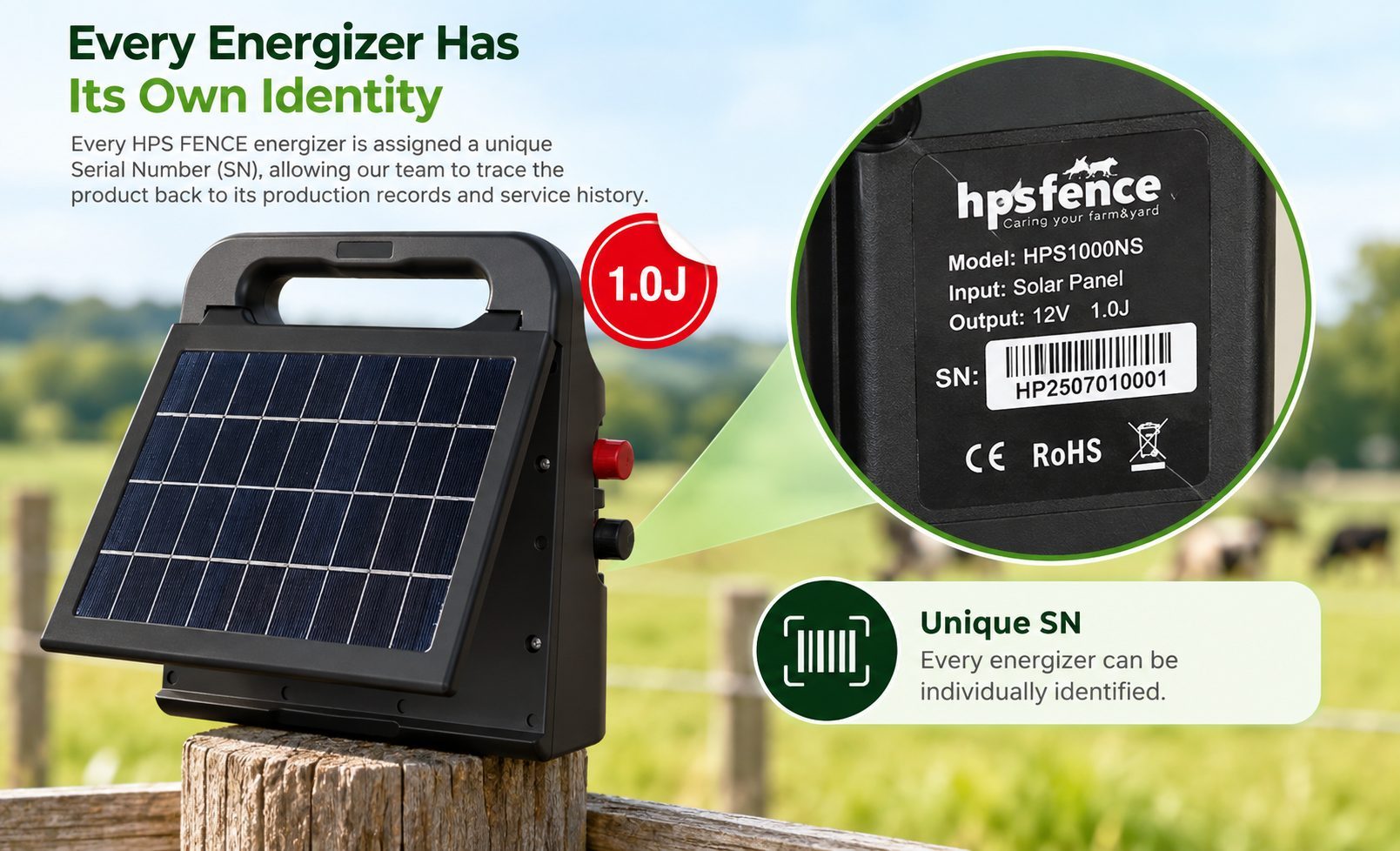
0.5 J stored · 7,000 V peak
Off-grid backyard and pet containment, 6 V 7 Ah battery included.
View product details
Solar · large
6 J input · 3.6 J output · 60 miles
Remote pasture where mains power will never reach. Rated by input, delivers 3.6 J.
View product detailsEvery unit in the range carries a two-year warranty. Where a datasheet quotes only an input figure, treat the delivered output as roughly 60% of it when comparing against a competitor — that ratio holds across our solar line from 3.5 J to 12 J.
Electric fence energizer vs charger: FAQ
Is a fence charger the same as an energizer?
Yes. Both names refer to the unit that generates high-voltage pulses. IEC 60335-2-76 uses "energizer"; farm suppliers in North America and Australia commonly use "charger".
Can I use a battery charger to power my electric fence?
No. A battery charger outputs 12–14 V DC to recharge a battery and has no high-voltage pulse output. It powers the battery, not the fence.
Why is my 6 J energizer weaker than a 5 J one?
Because one figure is input energy and the other is output energy. A 6 J input unit typically delivers around 3.6 J, while a 5 J output unit delivers all 5 J. Always compare the delivered figure.
Do I need a solar charge controller with a solar energizer?
Yes, if the energizer is charged from a panel. The controller regulates panel voltage to protect the battery. Many solar energizer kits include one; our HPSS-CONTROLLER is available separately for OEM builds.
Can one energizer run two separate fences?
It can run one continuous circuit. Two physically separate fences need either a connecting lead or a second energizer, because a single unit cannot pulse two isolated circuits at once.
HPS FENCE · MANUFACTURER & WHOLESALE SUPPLIER
Your Trusted Partner for Electric Fencing & Farm Solutions
From electric fence energizers and fencing accessories to poultry farming equipment, HPS FENCE supports global distributors, wholesalers, importers, and brands with reliable products, flexible OEM/ODM customization, and long-term supply solutions.
Sources
- IEC 60335-2-76:2002+A1:2006 and BS EN IEC 60335-2-76:2021 — electric fence energizers: terminology, output energy ≤5 J, pulse duration ≤10 ms, repetition rate ≤1 Hz.
- HPS FENCE product specifications — model ratings for HPSA, HPS, HPSS and JX series, including input and output energy values.
- IEC 60479-1 — effects of current on human beings and livestock, referenced for pulse-safety context.