Fence Energizer Troubleshooting Guide: Fix Weak Voltage, No Output and Storm Damage
- Share
- publisher
- HPS FENCE
- Issue Time
- Sep 15,2026
Summary
Weak fence voltage, no output, or a unit dead after a storm? This guide follows the same order our technical team uses: power supply, grounding, wiring, then the fence line, with a symptom-by-symptom table and the exact information after-sales needs to close your case fast.

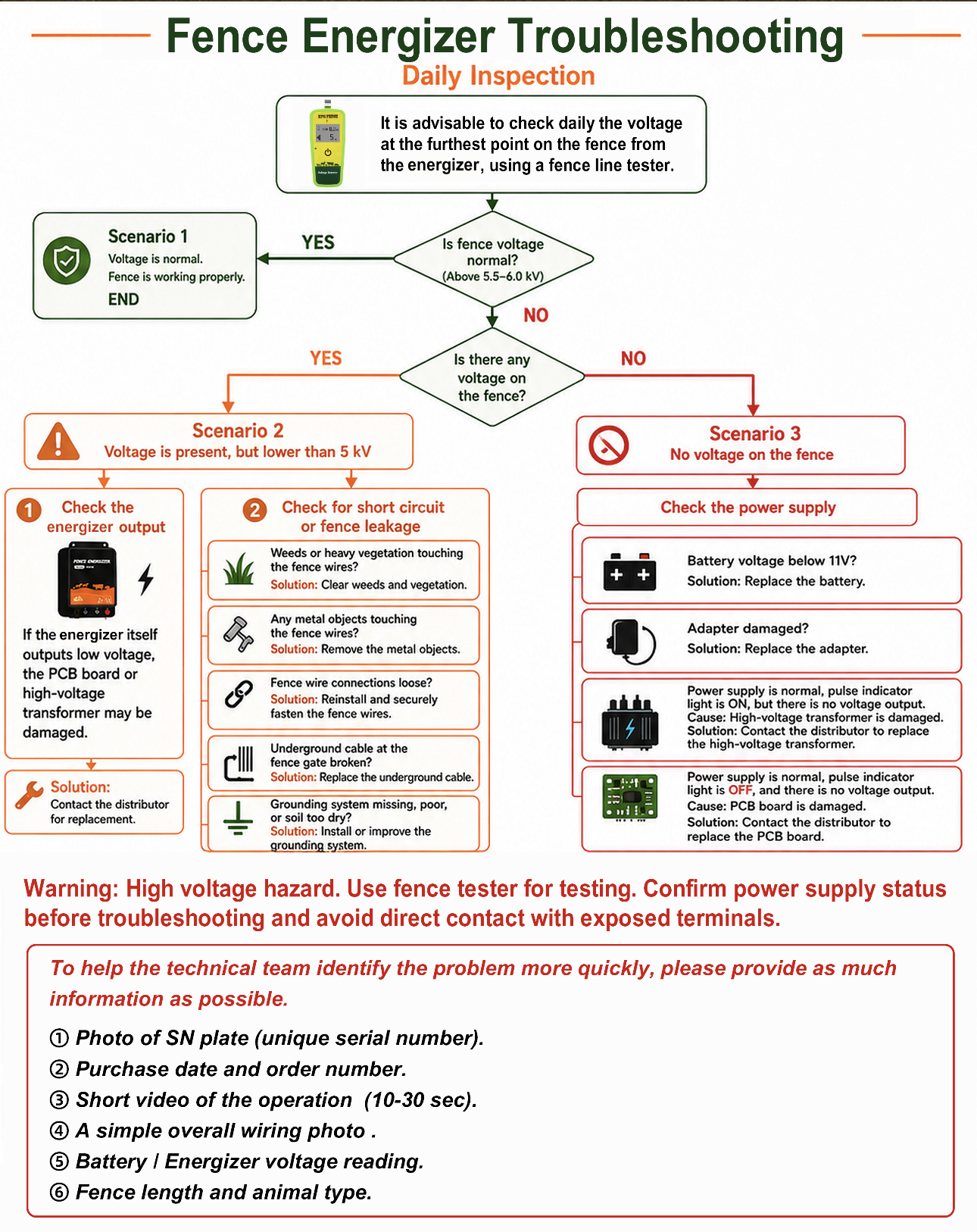
AFTER-SALES TROUBLESHOOTING A fence that loses voltage is not always a broken energizer. In most after-sales cases we handle, the unit is working correctly and the fault sits in the grounding, the wiring or the fence line itself. This guide follows the same order our technical team uses: confirm the symptom, test the power supply, check the grounding, then walk the fence. Direct answer Weak fence voltage is most often caused by poor grounding or a fence line shorting to ground. No output at all usually means the fence line is shorted or broken, or the power supply has failed. A unit that dies after a storm is normally a lightning-strike failure and needs a service case with the serial number (SN). Use a fence line tester at the point of the fence furthest from the energizer. Do not judge performance from the terminal alone. Above 5.5–6.0 kV is a healthy reading for most livestock fences. Below that, continue with the low-voltage branch. Measure the battery: it should be at least 12 V. For mains units, confirm the adapter output. Grounding is the single most common root cause of weak voltage. Confirm the rods are deep, spaced and connected with galvanized wire. Look for wires touching grass, weeds, metal posts, gates or fallen branches — every contact point leaks voltage. Why it matters: poor grounding means a weak fence, and a weak fence means animals walk through it. It is the most frequent root cause behind reported “energizer faults”. Never connect Fence (+) directly to Earth. Keep fence wire clear of metal posts, trees and tall grass. Fit insulators at every corner and gate. Keep total fence length within the energizer’s rated capacity. Bench test tip: if the energizer produces strong voltage at the terminal but nothing reaches the fence, the unit is healthy and the fault is in the fence line or grounding — not in the electronics. Send these six items and our team can diagnose your case in one round instead of several. Incomplete information is the main reason an after-sales case takes longer than it should. Every HPS FENCE energizer carries a unique serial number linked to its production batch, product version and factory test record. With the SN we can confirm the exact build, check whether the unit is still under warranty and compare its test data with the symptom you report. That is why a clear nameplate photo shortens diagnosis more than any other single item on the list. Because grounding or leakage is usually the limiting factor. Poor grounding, vegetation touching the wire, or a partial short to a metal post all reduce voltage at the far end of the fence while the energizer itself keeps working normally. Plan on at least three galvanized rods, each 1.5 m deep and spaced at least 3 m apart, connected with galvanized wire. Dry, sandy or rocky soil needs more rods or longer rods. Usually not. Loud clicking normally indicates overload: the fence is longer than the rated capacity or heavy vegetation is drawing current. Shorten the fence or clear the vegetation, then measure the voltage again. Lightning damage is treated as a service case rather than a material defect, but it is still worth submitting: send the SN, purchase date and photos so our team can confirm the failure mode and quote the fastest solution. First response within 4 working hours, an initial solution within 24 hours once complete information is received, and a target case closure within 72 hours excluding shipping time. HPS FENCE AFTER-SALES Send us the SN plate photo, your wiring photo and the voltage reading. Our technical team will tell you whether the issue is grounding, wiring or the unit itself. Sources: HPS FENCE installation & wiring specification and after-sales SOP. Field symptoms and remedies follow the standard energizer troubleshooting decision tree.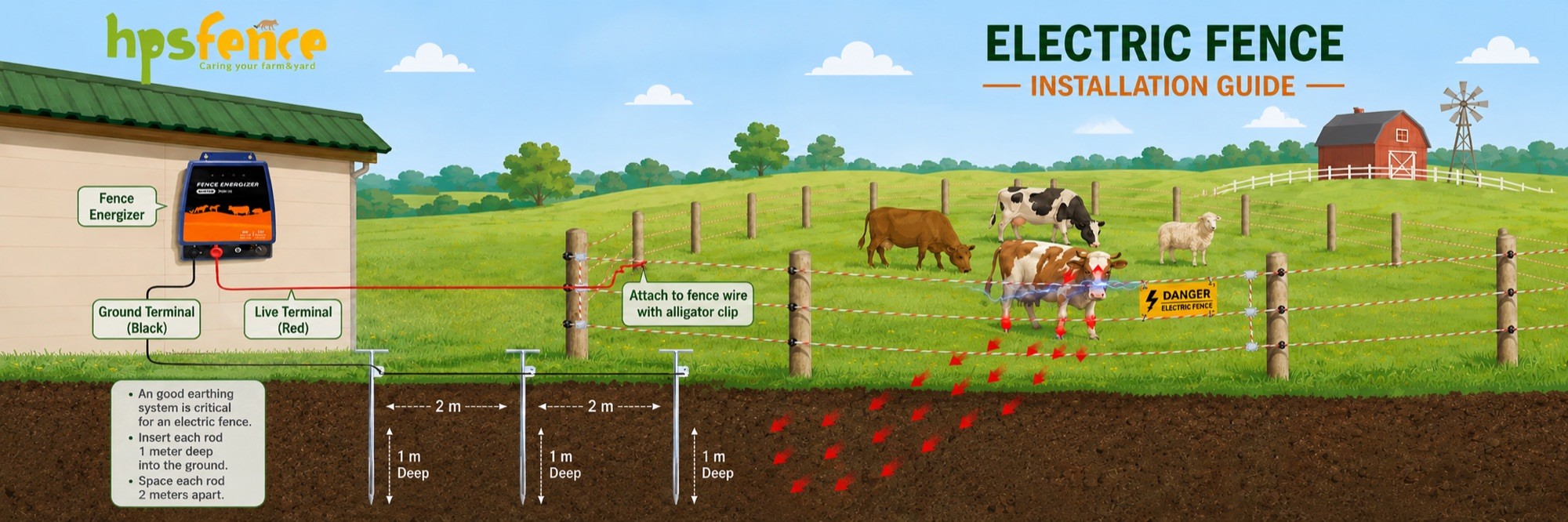
Fence Energizer Troubleshooting: Fix Weak Voltage and No Output
Start here: 5 quick checks before anything else
Test at the furthest point
Read the voltage
Check the power supply
Inspect the grounding
Walk the fence line
Part 1 — Installation: the two mistakes that cause most callbacks
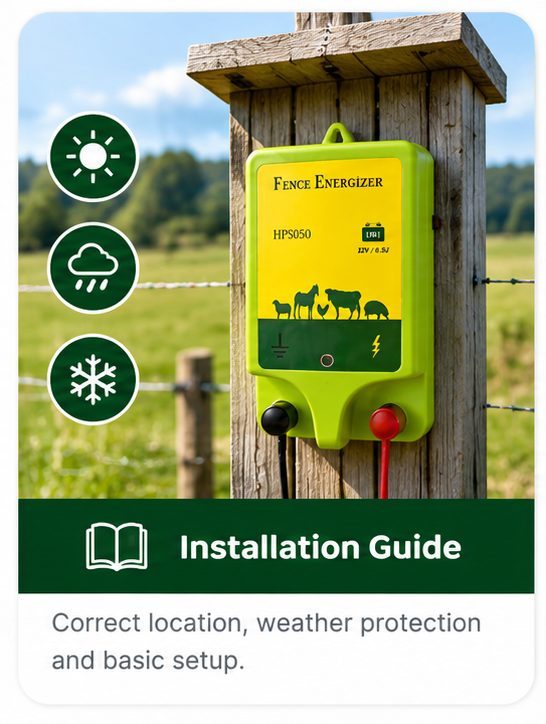
Where to mount the energizer
Grounding is not optional
Part 2 — Wiring: terminals and the rules that prevent shorts
Terminal
Function
Connect to
Fence (+)
High-voltage output
Live fence wire
Earth
Ground return
Grounding rod system
Battery (+/−)
12 V DC input
Battery or solar controller
AC IN
AC power input
110/220 V mains adapter
Part 3 — Symptom-by-symptom troubleshooting table
Symptom
Likely cause
What to do
Indicator light off
No power — flat battery or failed adapter
Check battery voltage (≥12 V) or measure the adapter output.
Indicator on, fence voltage weak
Poor grounding, or fence line shorting to ground
Add grounding rods, then walk the fence to find shorts against grass or metal.
No output voltage at all
Fence line shorted or broken
Disconnect the fence line and test directly at the terminal.
Loud clicking from the unit
Overload — fence too long or heavy vegetation
Reduce fence length or clear vegetation along the line.
Dead after a storm
Lightning-strike damage
Open a service case with the SN and purchase date.
Part 4 — What to prepare before contacting after-sales
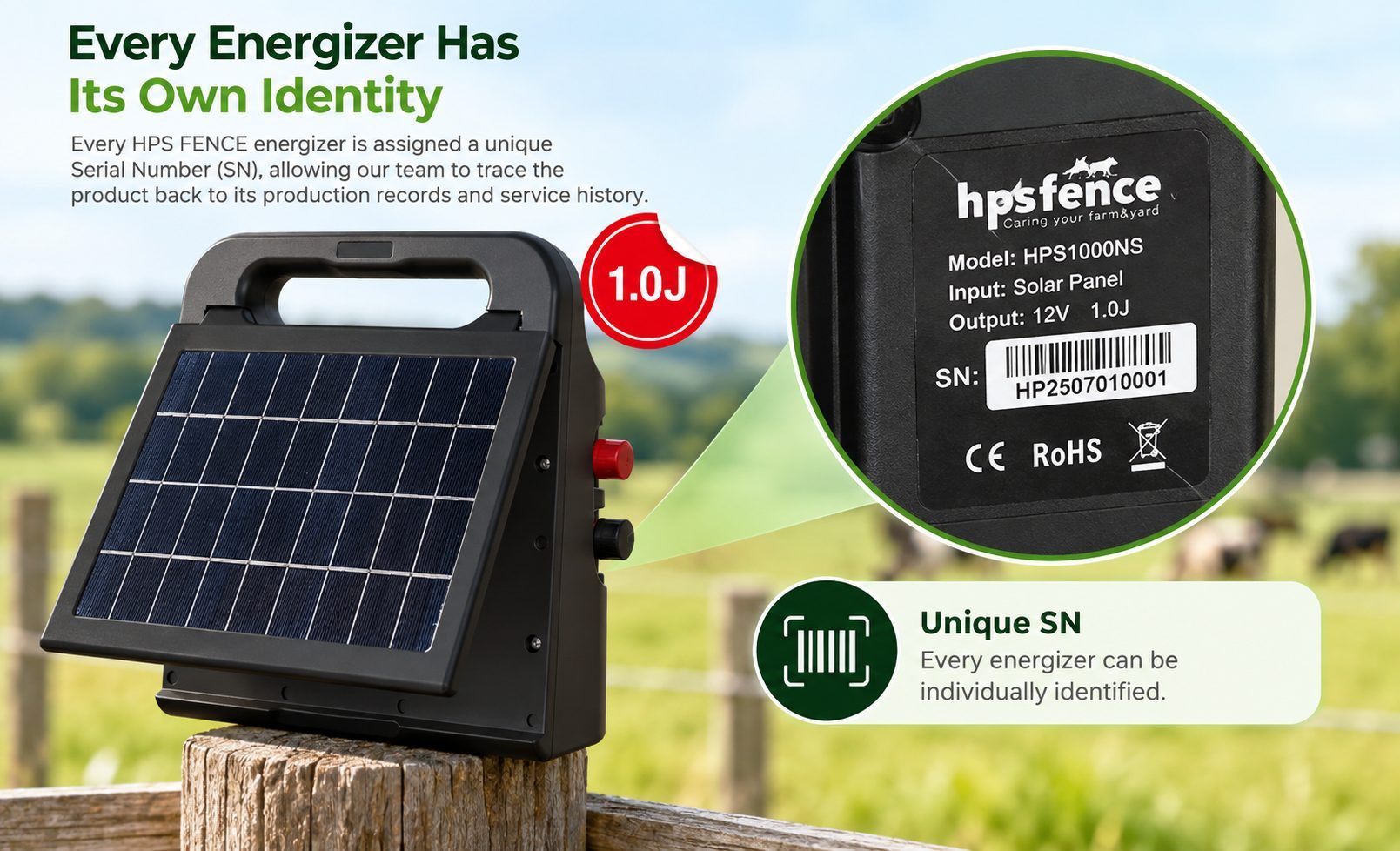
Why we ask for the SN
Frequently asked questions
Why is my electric fence voltage low even though the energizer is on?
How many grounding rods does an electric fence energizer need?
My energizer clicks loudly — is it broken?
Can a lightning strike be repaired under warranty?
How fast does HPS FENCE respond to an after-sales case?
Still stuck on a voltage problem?