How Does an Electric Fence Work? The Circuit Explained
- Share
- Issue Time
- Oct 20,2026
Summary
An electric fence stays open until an animal touches it. Follow the pulse from capacitor to ground rod, and learn why voltage alone will not stop livestock.

An electric fence works by keeping a circuit permanently open. The energizer pushes a short high-voltage pulse onto an insulated wire, the pulse has nowhere to go, and the circuit stays broken — until an animal standing on the ground touches the wire. At that moment the animal becomes the switch: current flows through it, into the soil, and back to the ground rod. The pulse ends in milliseconds and the circuit opens again.
A fence energizer charges a capacitor and discharges it roughly once per second as a pulse of up to 5 J lasting under 10 ms, measured into a 500 Ω load as specified by IEC 60335-2-76. Because the wire is insulated from earth, no current flows until an animal completes the path. IEC 60479-1 puts the perception threshold for a short DC pulse at about 2 mA and the AC let-go threshold at roughly 10 mA for men and 6 mA for women, which is why the pulse is felt sharply but does not lock the animal onto the wire.
Quick facts
- An electric fence circuit stays open until an animal touches the wire and completes the path to earth.
- Each pulse lasts under 10 ms, with at least one second between pulses.
- IEC 60479-1 puts the AC let-go threshold near 10 mA for men and 6 mA for women; a short DC pulse is perceptible from about 2 mA.
- In a 7-day trial, 47% of naive cattle were never shocked and 37% were shocked once (McDonald 1981).
How an electric fence circuit works
Think of the fence as a switch that is always open. The energizer keeps trying to push current around a loop, but insulation between the wire and the ground breaks the loop. Air and plastic hold the break.
An animal standing on soil is a conductor. When it touches the wire, it bridges the gap. The loop closes: energizer terminal, fence wire, animal, soil, ground rod, back to the energizer. Current flows for the duration of the pulse, then stops. The animal lets go, and the switch opens again.
This is why an electric fence is described as a psychological barrier. It does not resist the animal's weight. It gives the animal a reason not to lean on it.
Capacitor charged
The capacitor holds a fixed amount of energy, measured in joules — up to 5 J under IEC 60335-2-76.
Pulse released
A switching circuit dumps the stored charge onto the fence terminal as a high-voltage pulse.
Circuit completes
If an animal is touching the fence, current flows through it to earth and back to the rod. The pulse ends inside 10 ms.
Cycle repeats
The capacitor recharges and the next pulse fires, at no more than 1 Hz. The gap lets muscle tissue relax.
Why electric fence pulses are short by design
The rest interval is a safety feature, not an engineering compromise. IEC 60479-1 describes how current affects the body: at mains frequency, the let-go threshold — the point at which a person can no longer release a conductor — sits around 10 mA for adult men and 6 mA for adult women. Above roughly 30 mA, respiratory muscle tetanus becomes a risk.
A continuous high-voltage supply at those currents would be dangerous. A pulsed supply avoids the problem because the current stops before the muscle can lock. The chart below places the physiological thresholds next to the pulse format used by every compliant farm energizer.
Electric fence voltage vs joules: what each number means
This is the most misunderstood part of electric fencing. Voltage is the pressure behind the pulse. Joules describe how much energy is stored for each pulse. A fence can show 8,000 V on a tester and still fail to stop a bull, because the energy behind that voltage is tiny.
Voltage tells you whether the fence is healthy. Joules tell you whether the energizer is big enough for the job. A long fence with heavy vegetation needs both a high joule rating and a clean conductor, because vegetation drains energy from every pulse.
| Energizer rating | Typical use | Fence length guide |
|---|---|---|
| 0.25 J | Poultry netting, pets, small plots | Up to a few hundred metres of clean line |
| 0.5 J | Sheep, goats, temporary grazing | Short to medium runs, light vegetation |
| 1 J | Mixed livestock, small cattle herds | Medium runs, some weed pressure |
| 2–3 J | Cattle, horses, perimeter fencing | Long multi-wire runs |
| 5 J and above | Large properties, heavy vegetation | Very long runs or multiple fences |
Electric fence grounding: the half of the circuit that fails
Current must travel from the animal's feet through the soil to the rod, and dry or sandy soil resists that flow. A single short rod in dry ground can cut the voltage an animal actually receives by more than half, even while the fence tester reads a healthy figure at the wire — because the tester measures against the same poor earth.
A practical earth array uses three galvanised rods, each at least two metres long, spaced about three metres apart, driven where the soil stays damp and bonded with a continuous conductor. In very dry conditions, a fourth rod or watering the earth point during installation makes a measurable difference.
Test the earth, not just the wire
Measure between the fence wire and the ground rod, then between the wire and a temporary stake driven a metre away. A large difference between the two readings points to a poor earth rather than a weak energizer.
How fast animals learn an electric fence
The behaviour research matters because it shows how little exposure a working fence actually produces. In a seven-day trial with cattle that had never met an electric fence, 90% of all shocks occurred on the first day. 47% of the animals were never shocked at all, 37% received exactly one shock, and the remainder received two or three.
The pattern repeats across species. Feral pigs in a 100-hour observation received 61% of all shocks within the first 30 minutes. Feral goats were considered trained after seven days. A well-built fence produces a short learning period and then very little aversive contact for the rest of the season.
What drains voltage along an electric fence
- Vegetation: grass, weeds and overhanging branches touching the lower wire. The most common cause of a sudden drop after rain.
- Cracked insulators: hairline cracks leak current into wooden posts, especially in wet weather.
- Bare wire on metal: a conductor resting on a steel post, gate or water trough.
- Broken conductor: a single break stops the pulse beyond that point, which is why one section reads dead while the rest reads normal.
- Poor connections: corroded joints, loose clamps and undersized cable between energizer and fence.
- Long lead-out cable: thin cable over distance wastes energy before the pulse reaches the fence.

Electric fence power options: AC, battery and solar
Mains (AC)
Highest output for the price. Needs a dry, sheltered mounting point and a properly earthed supply. The default on farmsteads.
Battery (DC)
Suits remote paddocks. Output falls as the battery discharges, so a voltage check is more reliable than the indicator lamp.
Solar
Panel plus battery. Performance depends on panel angle, shade and battery condition; expect reduced output in winter.
Electric fence energizers for long runs and off-grid sites
If you are replacing a unit that keeps dropping voltage, the starting point is often a higher delivered output rather than a different brand. These four cover the common cases.
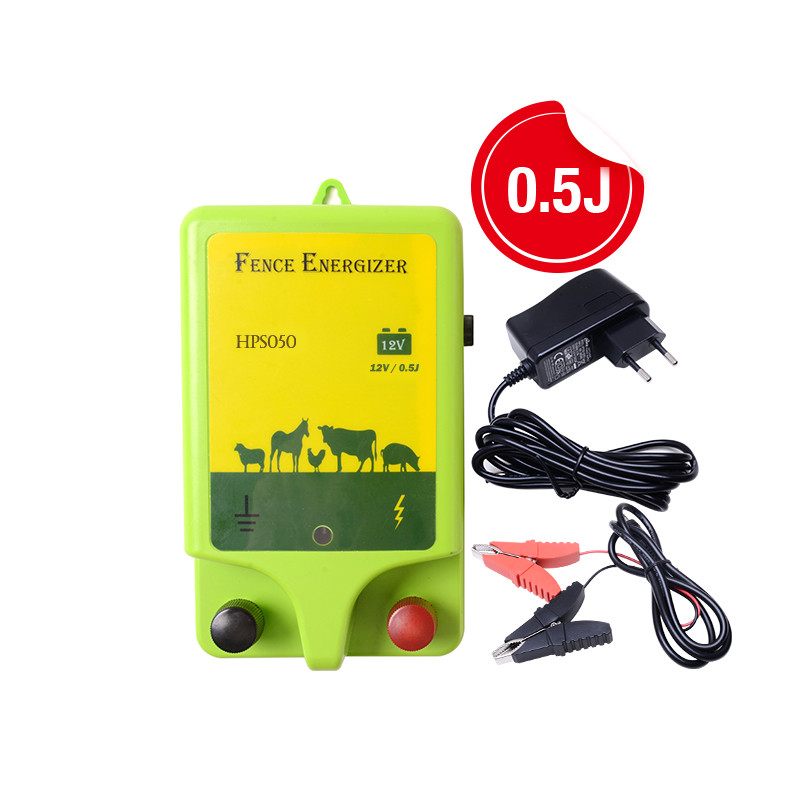
Dual source
0.5 J · AC 110–240 V + 12 V
Runs on battery when mains fails — the practical fix for unstable supply.
View product details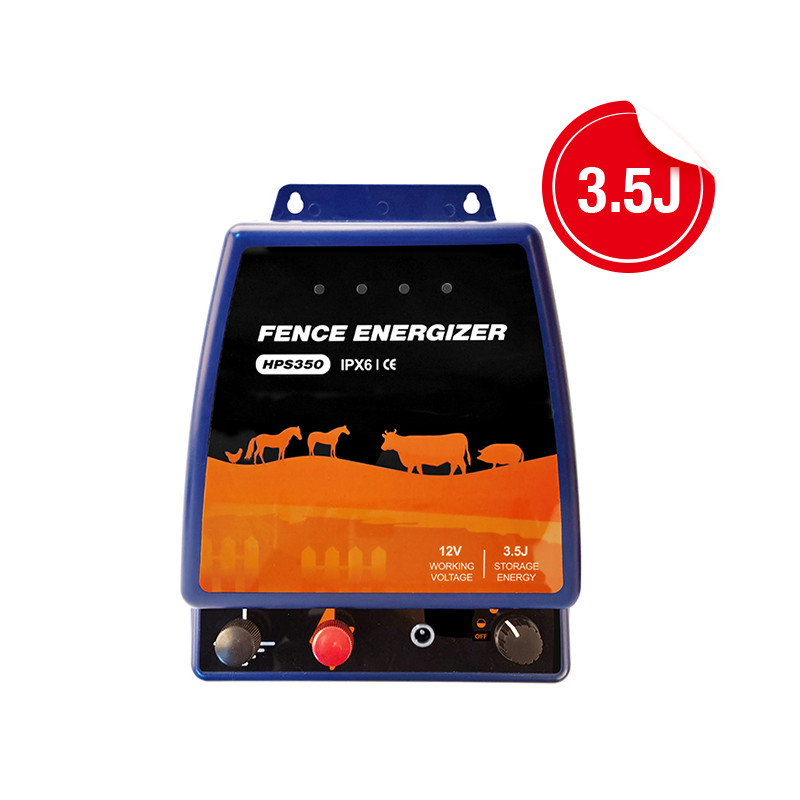
Long runs
3.5 J · 250 acres · 55 miles
Holds voltage across long multi-wire runs with vegetation pressure.
View product details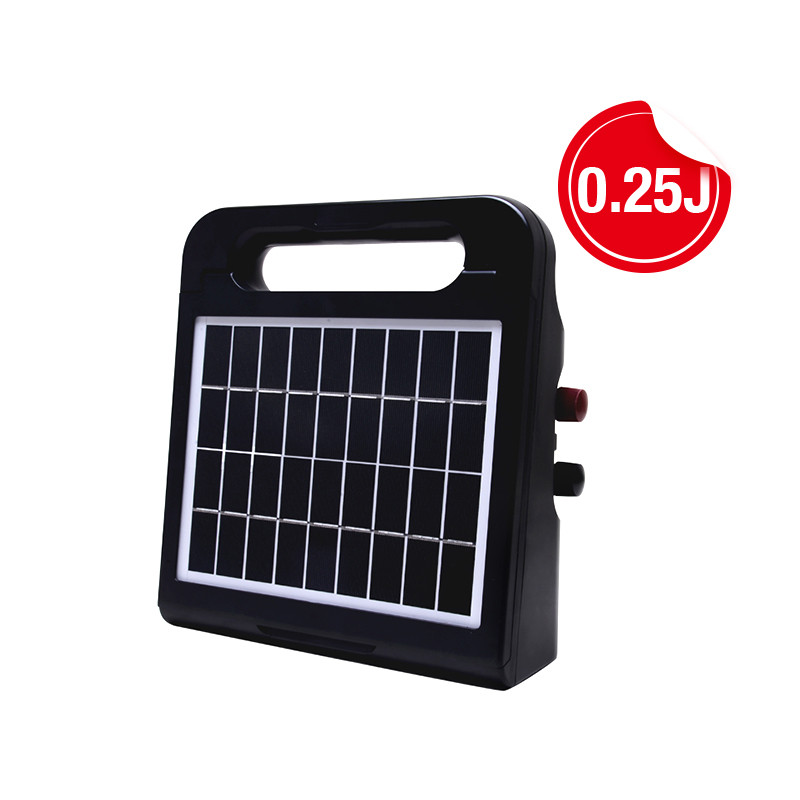
Solar · entry
0.25 J · 6,000 V peak
Off-grid poultry and pet fencing with a 6 V 7 Ah battery.
View product details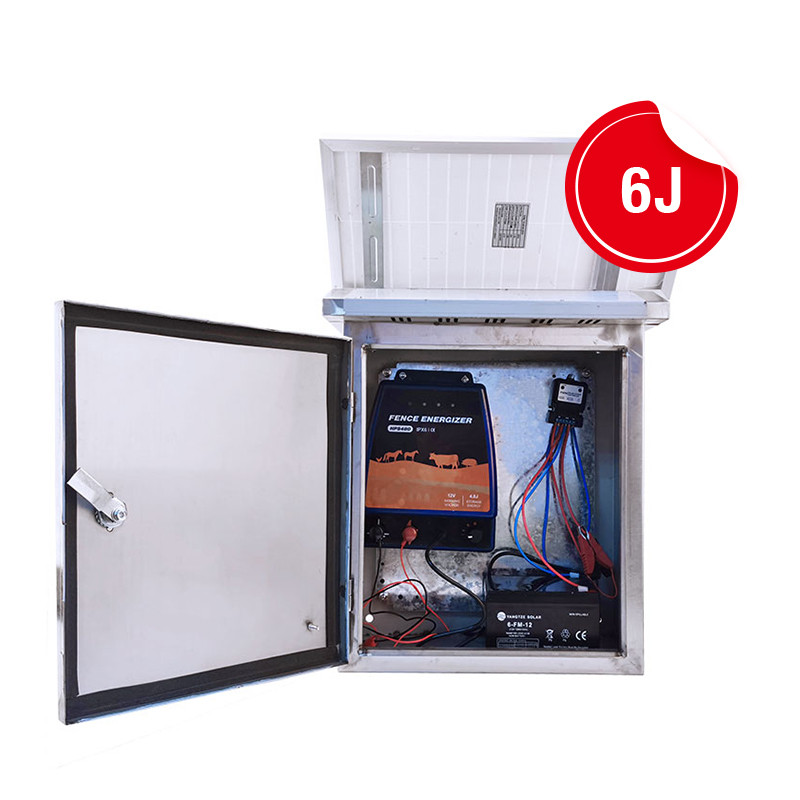
Solar · large
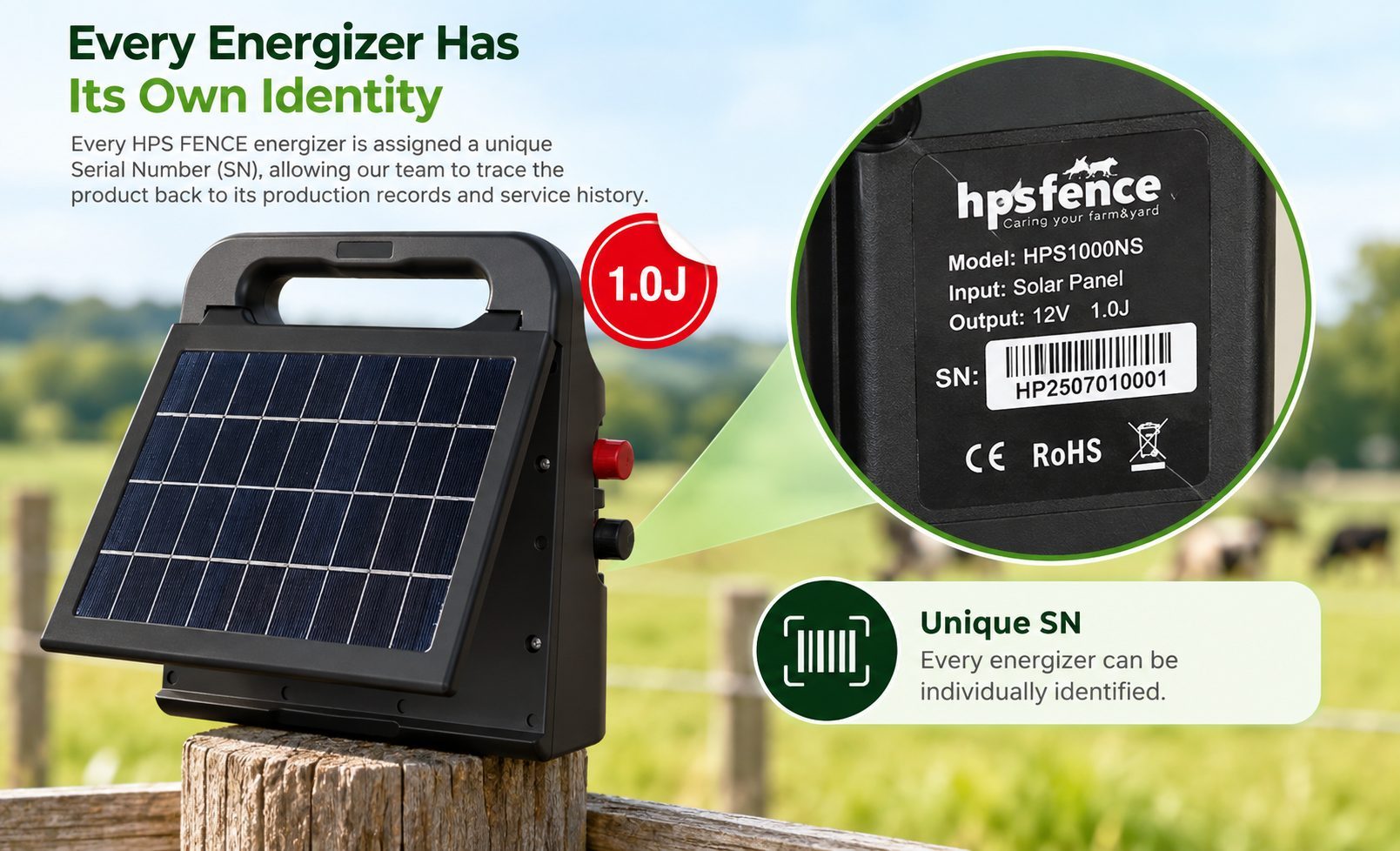
6 J input · 3.6 J output · 60 miles
Remote pasture where mains power will never reach.
View product detailsHow an electric fence works: FAQ
Does an electric fence use a lot of electricity?
Very little. A farm energizer draws only a few watts, comparable to a low-energy light bulb, because it delivers short pulses rather than a continuous current.
Why does my fence read high voltage but animals still cross it?
Voltage without energy is not enough. Check the joule rating against the length of the run, confirm the earth array is adequate, and look for a strong first contact. A fence that only tickles gets tested repeatedly.
Can I connect two energizers to the same fence?
No. Two energizers on one line can pulse out of phase and damage each other. Use one energizer per fence section, or separate sections with insulated gaps.
Does snow or frost stop an electric fence?
Frozen ground raises earth resistance and reduces the shock significantly. Adding ground rods below the frost line, or using a higher-output energizer, keeps performance acceptable through winter.
How often should I check the fence voltage?
Weekly in normal conditions and after every storm. A two-minute walk with a tester prevents most escapes, because voltage drops show up before animals find the gap.

HPS FENCE · MANUFACTURER & WHOLESALE SUPPLIER
Your Trusted Partner for Electric Fencing & Farm Solutions
From electric fence energizers and fencing accessories to poultry farming equipment, HPS FENCE supports global distributors, wholesalers, importers, and brands with reliable products, flexible OEM/ODM customization, and long-term supply solutions.
Sources
- IEC 60335-2-76:2002+A1:2006 and BS EN IEC 60335-2-76:2021 — electric fence energizers: output energy ≤5 J, pulse duration ≤10 ms, repetition rate ≤1 Hz, fault decay ≤300 ms.
- IEC 60479-1 — effects of current on human beings and livestock: perception thresholds, let-go thresholds and body impedance.
- VKM Report 2017:31 — Norwegian Scientific Committee for Food and Environment, review of electric devices used to modify animal behaviour, summarising McDonald et al. 1981 and Bartay et al. 1979.
- Glauser A. et al. — No increased stress response in horses on small and electrically fenced paddocks, Applied Animal Behaviour Science, 2015.