The Ultimate Guide to Choosing the Right Size Fence Energizer for Maximum Effectiveness and Safety
- Share
- Issue Time
- Sep 24,2025
Summary
Selecting the perfect fence energizer can be daunting. This comprehensive guide simplifies the process by breaking down the key factors you must consider: power source (AC, DC, Solar), joule rating, fence length, wire type, and the animals you're managing. Learn how to calculate your needs and choose an energizer that provides reliable, safe containment for your livestock or property, ensuring peace of mind and optimal performance from your electric fence system.
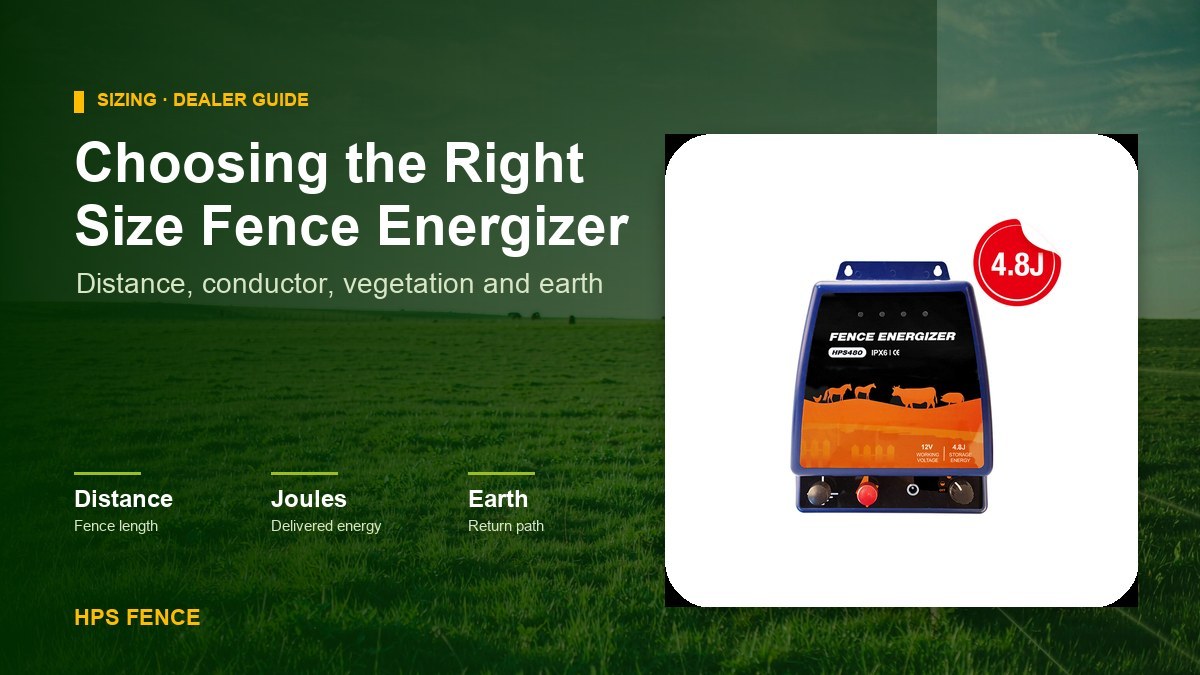
Most energizer returns are not failures. They are size errors: a unit chosen from the label rather than from the fence it has to drive. This guide turns sizing into four measurements you can take on site — distance, conductor, vegetation and earth — and shows what each one does to the joule figure you actually need.
Size an electric fence charger on total fence length and vegetation load first, then confirm voltage at the far end: about 2 J delivered for 20 km of clean cattle fence, 3.5 J for 30–55 km, 4.8 J where grass touches the wire, and 0.25–1 J for poultry netting. A 5000 volt reading at the terminals says nothing on its own — what matters is the reading at the end of the line and the energy behind it.
Quick facts
- Delivered joules are roughly 60% of the stored rating on a normal design, so a 6 J label is about 3.6 J at the fence.
- Voltage falls along the line: 7,000 V at the charger commonly reads 5,500 V at 2–3 km.
- IEC 60335-2-76 caps every pulse at 5 J, 10 ms and 1 Hz regardless of what the label claims.
- MOQ is one unit on energizers and testers, so a dealer can trial a size band before committing.
Why energizer size is a distance question, not a power question
A fence is a circuit: out along the wire, through the animal, back through the soil. Every metre of wire, every joint and every blade of wet grass adds resistance to that circuit, so the same energizer delivers less at 3 km than at 300 m. Sizing is therefore the act of predicting how much of the stored energy survives the journey — not of picking the biggest number in the catalogue.
Electric fence charger sizing: the four inputs
| Input | What to measure | Effect on the joule figure |
|---|---|---|
| Distance | Total length of live wire, including internal subdivisions | Linear: double the distance, halve the delivered energy |
| Conductor | Wire type, thickness, number of strands, joint quality | Thin or corroded wire adds resistance and wastes joules |
| Vegetation | Grass height and contact along the run | Heavy contact can halve effective coverage |
| Earth | Soil moisture, rod count and spacing | A poor return path loses more energy than a long fence |
Take all four before quoting. Any one of them can move the answer by a whole joule band.
How many acres or metres one energizer covers
Published coverage figures assume clean wire, dry conditions and a correct earth. Treated as a maximum, they are a useful starting point; treated as a promise, they are the reason customers complain in the wet season.
Indicative for permanent wire fence with a correct earth. Halve for heavy vegetation; for a two strand electric fence for cattle, keep the full band as margin rather than spending it on distance.
5000 volt electric fence: what the number tells you and what it hides
A 5000 volt reading is a healthy sign on a livestock fence, but it is a pressure measurement, not an energy measurement. Voltage can stay high while delivered energy collapses, which is why a fence can read 5000 V and still fail to hold a determined animal: the pulse is tall but thin.
Read voltage at three points — terminals, midpoint and far end. A gradual fall is resistance; a sudden step is a fault. Then ask the supplier for the delivered joule figure at a stated load, because that is the number voltage cannot tell you.
Two strand electric fence for cattle: size down, not up
It is tempting to assume fewer strands need less power. The opposite is true in practice: with two strands there is no redundancy, so a single short to grass removes a large share of the signal. A two strand electric fence for cattle should carry a full joule band of margin — 3.5 J delivered rather than 2 J — and the bottom strand should sit low enough to catch a nose before a shoulder.
- Two strands at roughly 450 mm and 900 mm, high-tensile wire, tight joints.
- One joule band of margin above the clean-fence calculation.
- Earth rods sized to output, not to habit: one 20 mm × 1 m rod per joule.
- A tester in the dealer's kit, because a two-strand fence has nowhere to hide a fault.
Electric fence energizer design: why the circuit beats the label
Two energizers with the same stored joules can differ by 40% in delivered energy, depending on transformer efficiency, switching losses and output impedance. Energizer design is therefore a better predictor of field performance than the number on the box. A well-designed 4.8 J unit will outperform a poorly designed 8 J unit on the same fence, and it will do so with less battery drain.
This is also why low-impedance design matters on long runs: the energizer has to push energy into a load that changes with grass and weather, not into a laboratory resistor.
What a size mistake costs a dealer
- One band too small: the customer adds strands, blames the product, and returns it in the first wet month.
- One band too large: a higher price the customer did not need, and a battery that drains faster on solar and 12 V units.
- Right size, wrong earth: the most common support call of all, and the cheapest to prevent.
- No tester in the first order: every voltage complaint becomes a site visit instead of a phone call.
HPS FENCE as an electric fence energizer manufacturer
HPS FENCE is the brand of Hangzhou Opus Fence Supplies Co., Ltd, building energizers in Hangzhou since 2013 with category experience back to 2002. Output spans 0.25 J to 12 J across mains, battery, solar and AC/DC formats, sealed to IPX6, and shipped to distributors in Australia, New Zealand, Europe, the United States, Canada, South America, Korea and Japan.
Real output test method published, not just a label value.
Read the test methodContinuous run with output, energy and temperature monitored.
See the production processPackaging verified for container and parcel transit before release.
See the drop testVerification tied to production batches, not a single prototype.
View certificationsEvery unit checked before packing, with batch traceability.
Inspection stepsOEM and private label for energizer ranges
Private label covers the housing label, retail box, manual, model naming, colour and output specification. Label-only changes start at one unit on stock models; a new housing or joule rating is quoted as an ODM project with MOQ confirmed per project.
Branding and packaging
- Logo on housing, retail box and manual
- Model naming and colour to suit your catalogue
- Packaging engineered for e-commerce and container transit
Technical and documentation
- Output voltage and joule specification per market
- Multilingual manuals
- Full ODM development with scheduling and sample approval
Wholesale terms for energizer buyers
Energizers by size band

0.25 J mains
0.25 J stored · 0.13 J delivered · 110–240 V AC
Poultry netting and garden runs on a mains supply.
View product details
2 J dual source
2 J delivered · 9 kV peak · AC or 12 V DC
20–50 head of cattle or a 20 km clean run.
View product details
3.5 J workhorse
3.5 J · 55 miles clean fence · 250 acres
Two-strand cattle fence with margin, or 50–150 head.
View product details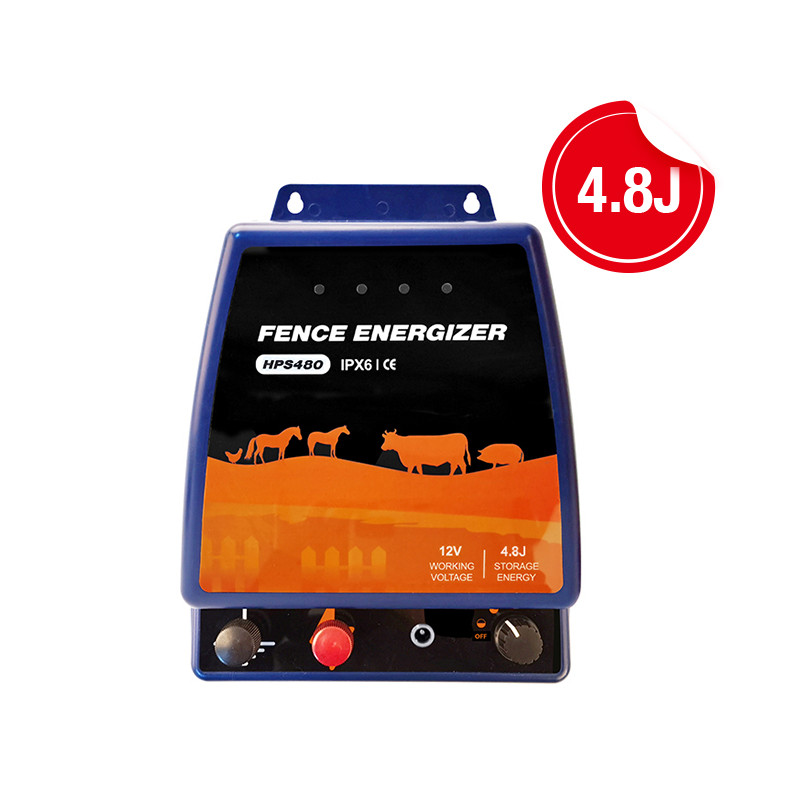
4.8 J heavy duty
4.8 J · AC 110 V · added power reserve
Long runs through grass and along wet boundaries.
View product details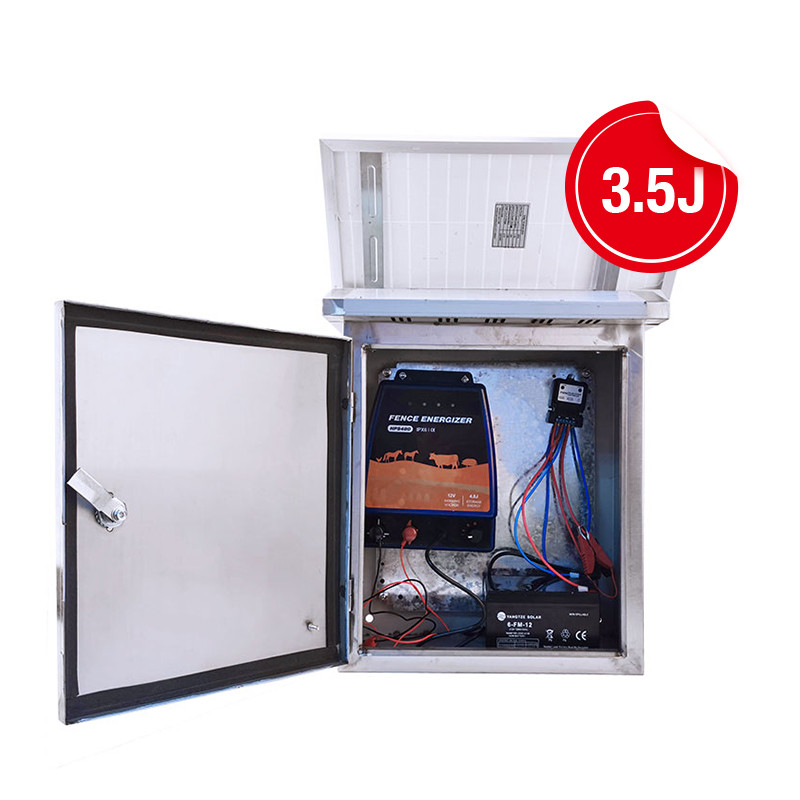
Solar 3.5 J
3.5 J input · 2.1 J delivered · 30-mile range
Remote paddocks with no mains supply.
View product details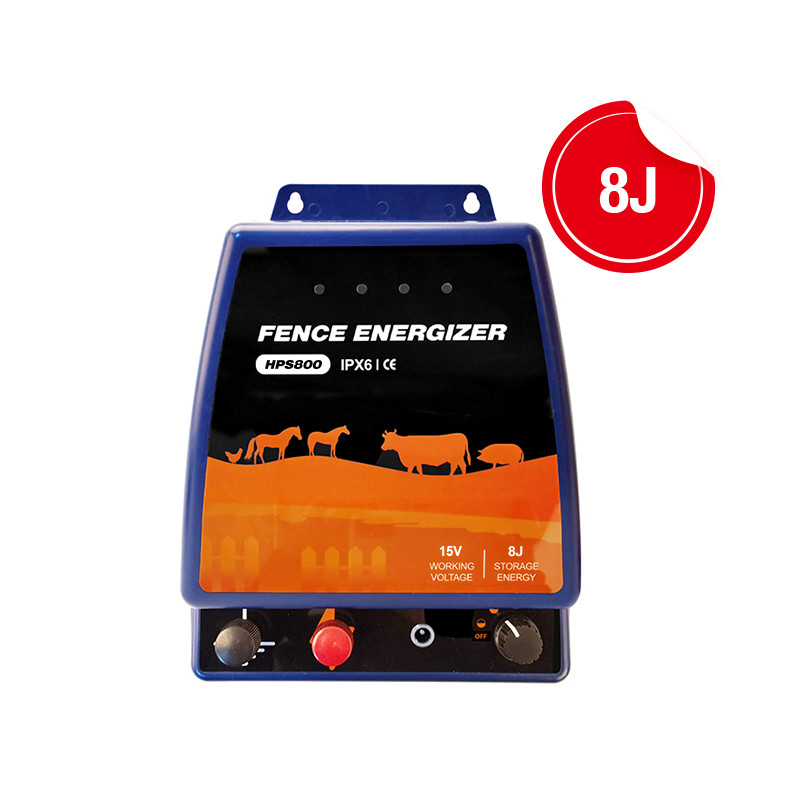
8 J high power
8 J input · 4.8 J delivered · 13 kV · 80 km
Reserves, wildlife and extreme fence length.
View product detailsRight size fence energizer FAQ
How do I know what size fence energizer I need?
Measure total live wire, note the conductor and vegetation, then read the published coverage for clean fence and step up one band if grass touches the wire or the earth is poor. Confirm the result with a voltage reading at the far end.
Is a 5000 volt electric fence strong enough?
5000 V at the far end is healthy for cattle and horses, but voltage alone is not the whole answer. Ask for the delivered joule figure as well, because a tall, thin pulse can read 5000 V and still fail to hold an animal.
Does a two strand electric fence need a bigger energizer?
Yes — one band larger than an equivalent five-strand fence, because a single short to grass removes a much bigger share of the signal when there is no redundancy.
How many acres will a 3.5 J energizer cover?
On clean permanent wire, roughly 250 acres or 55 miles of single-run fence. In heavy vegetation or on rocky, dry ground, treat that as half.
What is the MOQ for wholesale electric fence energizers?
One unit on energizers, testers and coop doors; 100 units on other categories. Mixed-model orders are accepted, so a dealer can carry several size bands without a large commitment.
Sources
- KZN Department of Agriculture & Rural Development — Electric Fencing in Agriculture: voltage minima, earth rod requirements, conductor spacing.
- IEC 60335-2-76:2002+A1:2006 / BS EN IEC 60335-2-76:2021 — output energy ≤5 J, pulse duration ≤10 ms, repetition rate ≤1 Hz.
- IEC 60479-1 — effects of current on human beings and livestock.
- HPS FENCE product specifications — delivered output energy, coverage and power source across the 0.25–12 J range.
- HPS FENCE — How to Test Real Output: measured efficiency and the stored-versus-delivered gap.
Related energizer sizing guides
- How Many Joules for an Electric Fence? Sizing by Species and Distance — the joule figure for cattle, horses, dogs, deer and poultry netting.
- Best Electric Fence Energizer: 7 Models Ranked — the model shortlist once the size band is decided.
HPS FENCE · MANUFACTURER & WHOLESALE SUPPLIER
Your Trusted Partner for Electric Fencing & Farm Solutions
From electric fence energizers and fencing accessories to poultry farming equipment, HPS FENCE supports global distributors, wholesalers, importers, and brands with reliable products, flexible OEM/ODM customization, and long-term supply solutions.